How a Fortune 100 insurer stopped debating AI and started proving it

From scepticism to structured proof: how a hypothesis-driven R&D sprint gave a global insurer's engineering teams the evidence they needed to move.
The Client
Liberty Mutual is one of the world's largest insurers, with engineering teams spread across geographies building complex systems at enterprise scale. When AI became an unavoidable strategic priority, their teams weren't short of curiosity. What they needed was a structured way to separate signal from noise — and the evidence to justify moving forward.

The Challenge
Individual experiments. No shared evidence.
The engineering organisation had engineers experimenting with AI tools across the codebase. But experimentation without structure produces opinions, not decisions. Leadership needed to know which use cases were worth investing in, which weren't, and what a rigorous, repeatable approach to AI validation looked like inside their specific environment.
Without a structured evaluation framework, every team was drawing its own conclusions — and no one could agree on what to build next.

What We Did
A hypothesis-driven sprint to produce structured proof.
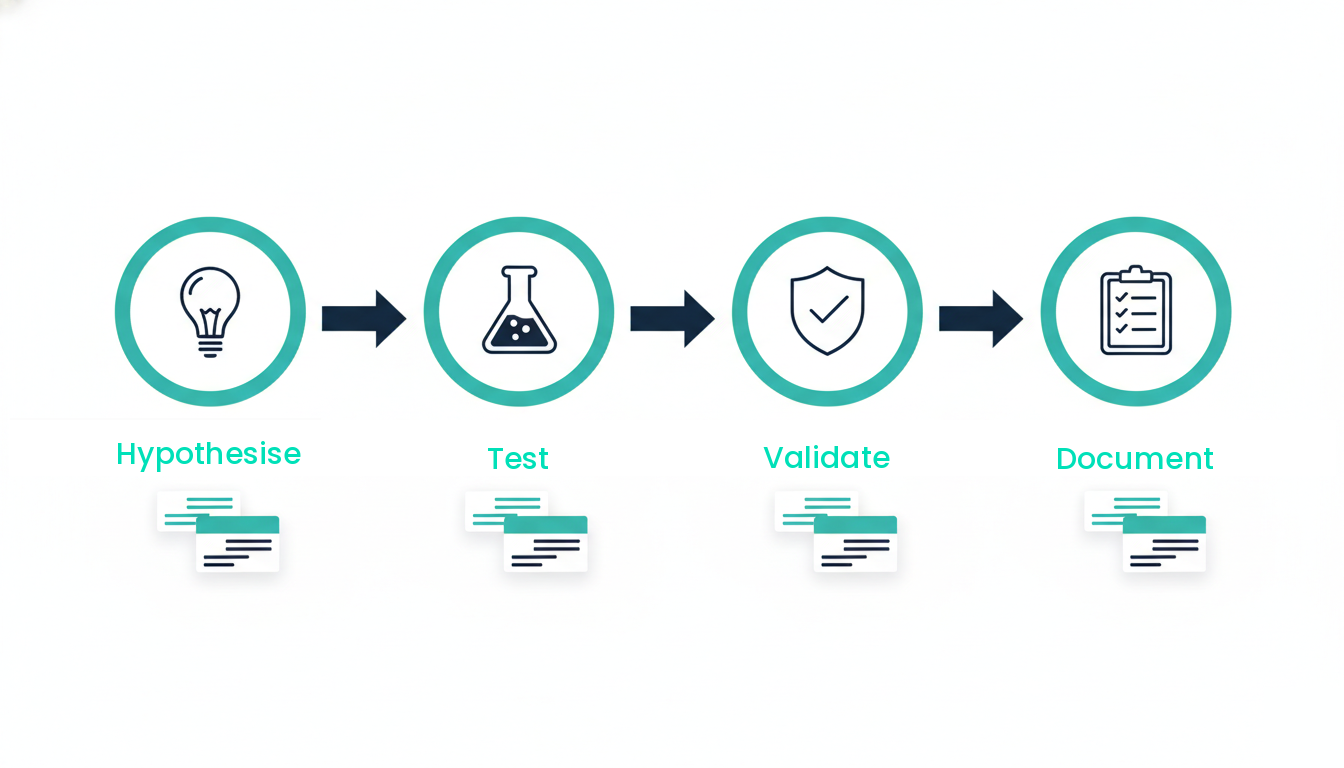
MISSION+ ran a focused ACDC sprint — an AI R&D framework designed to produce validated evidence within weeks, not quarters. Embedded alongside the engineering teams, we co-developed a hypothesis-led evaluation methodology: defining use cases, building test prompts, and measuring outcomes against real codebases and workflows.
We worked across code generation, documentation, and code review tasks — testing what AI could meaningfully accelerate, and what it couldn't. Every finding was documented, structured, and made reusable so the learning stayed inside the organisation.
The Impact
5 use cases validated. 45+ prompts tested. A team that can now move.
The result was a body of evidence — not a pilot, not a prototype, but structured proof that could be presented to leadership and used to drive real prioritisation decisions.
The engineering teams left the sprint with shared vocabulary, validated methods, and the confidence to build on what they'd learned.
Over the course of the engagement, we validated 5 high-priority use cases across the SDLC, tested 45+ prompts, built 18 reusable knowledge articles, and upskilled 10+ developers through embedded coaching and structured knowledge transfer.

It all began with brainstorming sessions for a new name, which took time to get right
Heading 1
Heading 2
Heading 3
Heading 4
Heading 5
Heading 6
Lorem ipsum dolor sit amet, consectetur adipiscing elit, sed do eiusmod tempor incididunt ut labore et dolore magna aliqua. Ut enim ad minim veniam, quis nostrud exercitation ullamco laboris nisi ut aliquip ex ea commodo consequat. Duis aute irure dolor in reprehenderit in voluptate velit esse cillum dolore eu fugiat nulla pariatur.
Block quote
Ordered list
- Item 1
- Item 2
- Item 3
Unordered list
- Item A
- Item B
- Item C
Bold text
Emphasis
Superscript
Subscript



The window is 24 months
Let's talk.
Book 30 minutes with someone who's already done this.