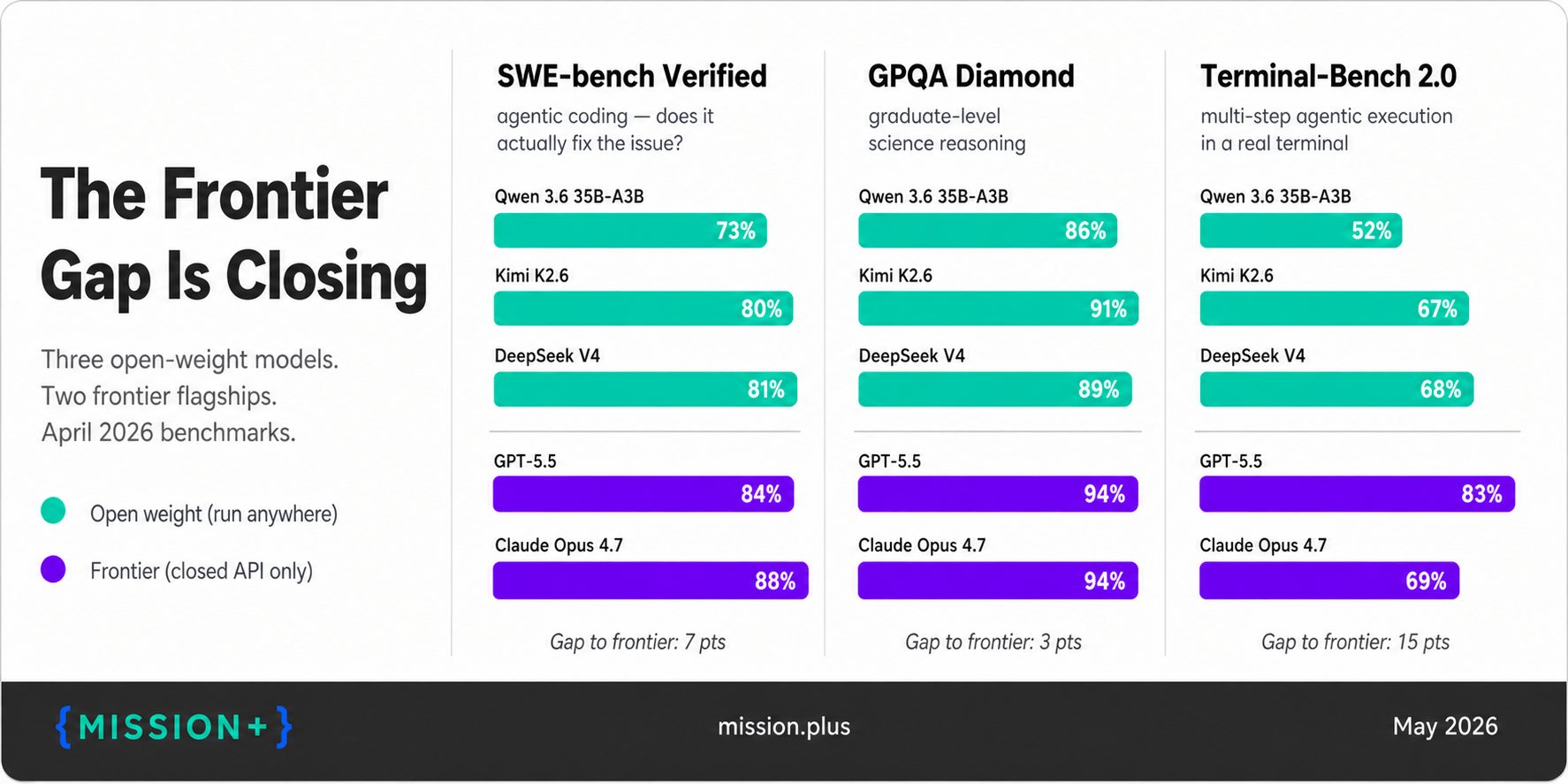
Within a single week we got Qwen 3.6, Kimi K2.6, and DeepSeek V4. Well, GPT 5.5 and Opus 4.7 also dropped in that same window - but our story isn't about them.
The frontier no longer exclusively belongs to the most well-funded labs. The gap between the leading open-weight Chinese models and their closed-source American cousins on benchmarks like multi-step task completion, tool call accuracy, and agentic coding tasks has shrunk to low single digits. Close enough to practically call it a tie for most of the engineering work most of us do. And these things run on hardware at roughly an order of magnitude lower cost than the US frontier APIs. That shifts some of our thinking away from ‘can we achieve this outcome’ to ‘how cheaply can we achieve this outcome’.
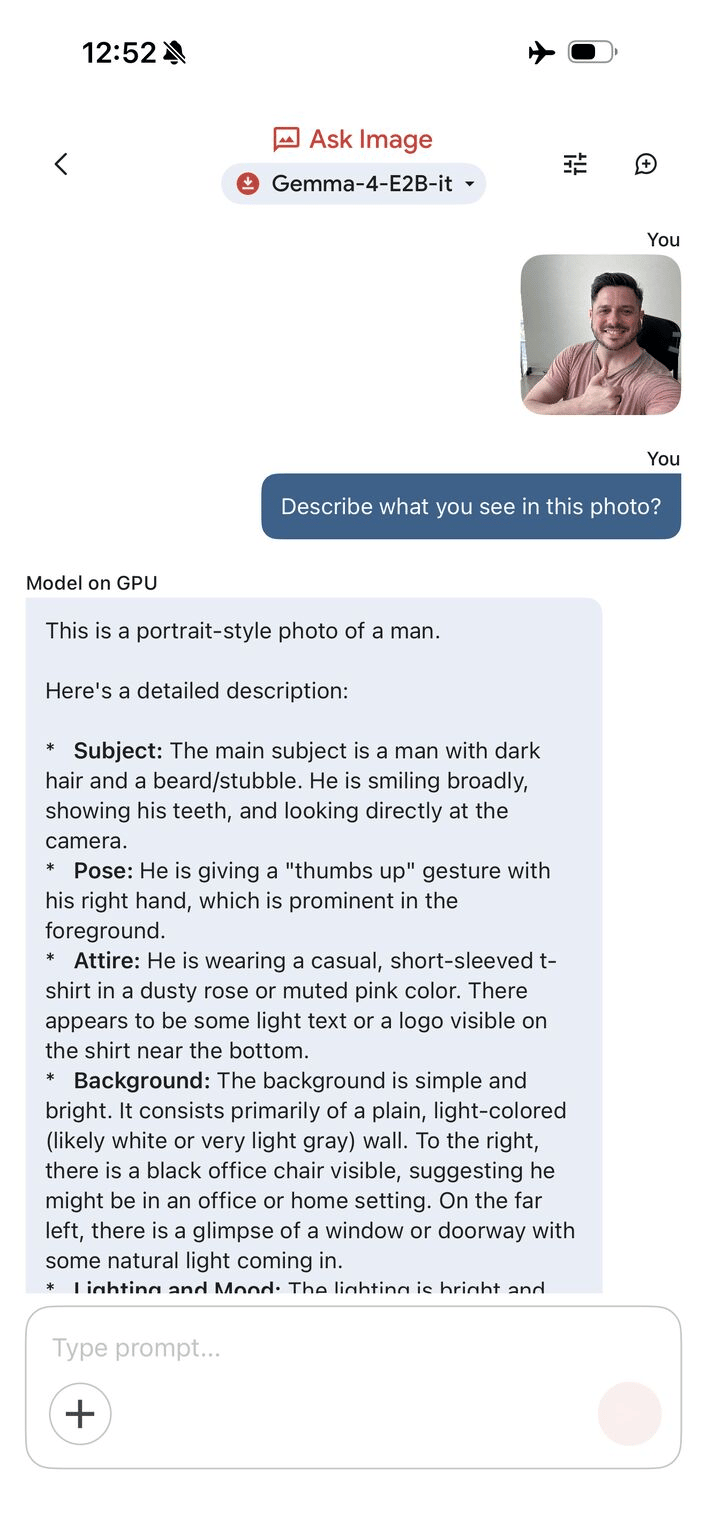
Slightly earlier in the month we got Google’s Gemma 4. This is small enough to run on an iPhone. Not "running on your beefy M3 Mac" or massive Nvidia GPU... On your phone. Honestly, I’m still a little in disbelief on this - as are people I demo it to, who pretty much every time ask “where is it getting the data from?” when I turn on airplane mode.
Sure, the smallest variant isn't going to one-shot a refactor of your ancient code base, but it'll handle local summarisation, classification and tool routing without ever touching a network. And the larger, but still locally running, version will happily allow you to code on an airplane (actually let’s not do that, that is a sacred space). Whole categories of "ship the user's data to a third party" architecture just became unnecessary, and a bunch of privacy-minded individuals breathed a huge sigh of relief.
OpenAI quietly released Privacy Filter - an open-weight PII masking model under Apache 2.0. 1.5B params total, only 50M active thanks to its Mixture of Experts architecture. WebGPU, transformers.js, weights cached in IndexedDB - it runs in your browser! This is the new pattern: small specialist models sit at the edge, sanitise the inputs, and only then hand off to the big hosted model. Defence in depth, locally.
I couldn't help but notice the launch of USVC - a new closed-end fund chaired by Naval himself, giving retail investors exposure to OpenAI, Anthropic and xAI from $500. Patriotically named, but at least a 3.61% gross expense ratio and "highly illiquid" (their words not mine), combined with a structure that sidesteps accredited-investor rules. Is this the savvy democratisation of Silicon Valley, or a beautifully-orchestrated way to offload paper from the private investor to the retail punter? Calling the top of the valuation of the private labs? Maybe - let's check back in later this year.

Reflections On The Mission
In Spec Driven Development, we write detailed specifications to maximise the probability that a coding agent produces the outcome we actually want. Some have taken this to an extreme conclusion: the spec becomes the new source code, and the actual code is just a disposable derivative like the compiled binary. Delete it, regenerate it, ship it. Specs all the way down.
There's a problem with this line of thinking though. The spec → source process is probabilistic. The source → binary process is deterministic. So every regen produces a slightly different codebase: a different choice of error string here, a different stacking order there, a subtly different SQL query in a place that maybe shouldn't matter… But it does.
To stop the non-deterministic drift, you'd have to pin every variant down inside the spec. The exact wording of every toast message. The exact tab order of every form. The exact retry policy for every failed call. My brother, what do you think source code is? It's a precise specification, written in formal language, that a deterministic compiler can interpret without ambiguity. We invented this for a reason. Yeah ok the syntax is ‘uglier’ than English, but that's a feature, not a bug.
So the interesting question isn't "spec versus code." It's "where in the stack do I stop being human-friendly and start being machine-precise?" High-level intent (“users can recover their account if they lose their password”). The exact regex that validates the email field? That's source code. Dressing it up in markdown bullets won't help anyone. If you find your spec creeping towards literal assertions about pixel offsets and timeout values, you haven't replaced source code. You've reinvented it, in a slower, fuzzier dialect.
Deepwiki, from the Cognition crew behind Devin, is a revealing insight into this. Swap github.com for deepwiki.com on any public repo and you get an AI-generated wiki, with architecture diagrams, module-level explanations, dependency maps and a chat assistant, all grounded in the actual code. It automatically regenerates as the code changes. It walks the fine line between a form of spec and code - it is detailed enough that a reader fully understands the application, but it doesn’t expose actual implementation details. An actual spec would spend more time talking about intent and less about architecture, but the point stands. This is the level of agent-assisted detail we should be aiming for in the future.
Interesting Articles
- LLM Leaderboard for Code Quality & Security - our friends at Sonar compare different models for things like number of lines of code to pass challenges, and coding issue density. Just ‘passing a test’ isn’t enough - how you pass it is important!
- NanoClaw — Personal Claude Assistant (second brain for a diplomat) - Vivian Balakrishnan is Singapore’s Minister of Foreign Affairs. And apparently he has also succumbed to the desire to run a Claw.
- Commentary: Anthropic’s ‘too dangerous to release’ Mythos AI model is a wake-up call for everyone - some of the “omgz this is just too dangerous” language is marketing rhetoric, but the fundamental idea that AI-augmented vulnerability scanning is now a part of life is all too real. Time to shift to AI-augmented defence and pen testing.
This Is The Way

Feature A Fractional

We’re On A Mission

Until next month. Together, We Build {+}
Ned & the MISSION+ team
P.S. If you would like to bring the MISSION+ team into your organisation to help, please reach out to [email protected]!