Fable is back. ‘Twas but a blip.
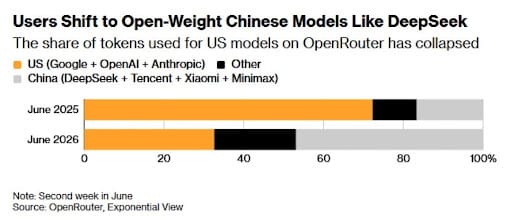
Cue lots of conversation about model capability, what we consider ‘safe’ to release, and the potential futility of trying to control things as open weight models catch up.
Whilst interesting, that misses the bigger point and the thing enterprise should be actively discussing right now: can we trust American technology to not get yanked away without warning?
Sure Fable was in beta, so the blip didn’t truly impact us very much. But what if there were significant production workloads? And this isn’t really an AI problem, it’s true of any technology.
Anyone who has worked in a regulated industry has always had to carefully consider Disaster Recovery (DR) and Business Continuity Planning (BCP). If a service or vendor goes out of business or is unavailable, what’s the plan? For example, under the EU's DORA and the UK's operational resilience rules, financial firms must not only plan for an outage but also document and test a viable exit strategy for every critical third-party provider.
One option is to adopt the so-called “East-West” strategy. The US isn’t the only game in town, so enterprises can mirror their Western vendors with Chinese counterparts. A pity there aren’t more viable options right now, but I’m sure they’ll come one day.
The East-West strategy is a good one, but doesn’t guarantee anything. Beijing is also looking at curbing overseas access to China’s top AI models, and there has always been persistent doubt around using Chinese infrastructure (whether valid or not).
Is a shift to self-owned technology inevitable? Anti-cloud advocates have long said “There is no cloud, it's just someone else's computer.” Does this all result in privately hosting AI models - potentially compromising capability against continuity?
Literally hosting models is complicated and requires up-front infrastructure investment, but might make sense for some. For others, using an in-country provider might make more sense. Much of AI processing is transient compute. Using stateless model providers would allow us to route to wherever there is capacity. There is a huge opportunity here for the neo-clouds, or even the traditional players like AWS (particularly through their partnership with Cerebras).
The space is maturing fast, the risks are only beginning to be understood. We’re just getting started!

Reflections On The Mission
What parts of “programming” are still worth learning as a beginner? What is still useful, nay, necessary in order to be effective in a world where agents can generate the code?
As I was pondering this question, I had a bit of an epiphany. There is a clear correlation between the topics we need to learn, and those that are still useful to put into documentation - or even an agentic specification. Those are the bits that humans read, so clearly the bits we need to understand!
Deepwiki produces detailed documentation on a source repo. This is free for public repositories, or part of Devin for private ones. What it chooses to catalogue is essentially a guide to what a beginner should learn.
What does that look like? Obviously the architecture - the result of thinking in clear abstraction layers. Although I’m not sure how one learns that, which is maybe a topic for another time. Struggling students have often despaired to me that they can clearly see the outcome they want - they just can’t see the path to get there. My advice has always been to break the big problem into smaller, but still significant, steps, and then break them up - and so on.
At the other end of the spectrum - memorising syntax is probably a waste of time for many. No need for that to be in the docs!
What are the topics in between these two extremes? Performance scaling methods seem important, if only to make sure they’re not applied too early by an overly eager AI agent. Testing & verification, along with governed deployment mechanisms, is more important than ever.
At least for now, how to structure data and databases is still necessary. Source code is stateless, and agents are great at refactoring it. Not always the case for stateful data, and the associated migrations that are sometimes needed.
Beyond the documentation, a deep understanding of security principles is a must. The security strategy is often not part of documentation, but it can’t be forgotten! As my friends at AWS often say, "Security is Job Zero".
But other than that, my advice to beginners looking to go deeper would be to just start reading through the Deepwiki entry for an open source project that interests you, and use your favourite AI to explain any of the terminology you don’t understand!
Interesting Links
- Announcing the Monetization Gateway: charge for any resource behind Cloudflare via x402 - interesting use case for stable coins.
- How Google SRE is using agentic AI to improve operations - we’ve all been quite focused on agentic build, but the run/ops side of things is equally important! MISSION+ will be publishing more on this topic soon.
- The 2026 AI Engineering Report - a VC-published survey of over 1000 engineers on their usage of AI engineering.
This Is The Way

We’re On A Mission


Until next month. Together, We Build {+}
Ned & the MISSION+ team
P.S. If you would like to bring the MISSION+ team into your organisation to help, please reach out to [email protected]!